United State
united state
breaking
latest
fresh
March 04, 2026
• FactCheck.org
Legality of Latest Iran Attack in Question
Many Democrats have claimed that President Donald Trump didn’t have the legal authority to unilaterally order the Feb. 28 joint military airstrikes with Israel that resulted in the death of the supreme leader of Iran, Ayatollah Ali Khamenei.
Experts have told us that, according to an originalist interpretation of the U.S. Constitution, congressional approval for the use of military force against another country is required. Article I, Section 8 of the U.S. Constitution gives the power “To declare War” to Congress.
However, in practice, several presidents have unilaterally ordered military action abroad without authorization from Congress.
In this story, we’ll look at what Democrats have said about Trump’s latest military order and review what experts already told us in similar past cases.
Claims of Illegality
Not long after the attack on Saturday, several Democrats were quick to criticize Trump’s military operation in official statements or media appearances.
Sen. Ruben Gallego of Arizona said in a Feb. 28 statement on his congressional website, “President Trump promised no more forever wars. Instead, he has illegally dragged us into another one without congressional authorization and no long term strategy.”
Sen. Tim Kaine of Virginia called it an “illegal war” on “Fox News Sunday” on March 1.
“The Constitution says no declaration of war without Congress,” he said. “The president has called this war against Iran. The president can act to imminently defend the United States against imminent attack, if that happens, without congressional approval, needing later ratification by Congress. But if you’re going to initiate war, you need Congress. The president not only did not come to Congress to seek a debate or vote, he acted without even notification to the vast majority of us.”
That same day, on CBS’ “Face the Nation,” Sen. Chris Murphy of Connecticut also called Trump’s actions “illegal” without authorization. “Congress wouldn’t vote to give him the permission to do it, but he’s obligated to come to Congress,” Murphy said.
But Secretary of State Marco Rubio said that members of Congress were informed consistent with current law.
“We notified Congress,” Rubio told reporters in a March 2 press gaggle. “I mean, we notified the Gang of Eight. We notified congressional leadership. There’s no law that requires us to do that. The law says we have to notify them 48 hours after beginning hostilities. We’ve done that.”
The Gang of Eight refers to a special group of eight members of Congress, including the four top Republicans and Democrats in the House and Senate, as well as the chairperson and ranking member of the House and Senate Select Committees on Intelligence. White House Press Secretary Karoline Leavitt wrote on X that, prior to the attacks, Rubio “called all members of the gang of eight to provide congressional notification, and he was able to reach and brief seven of the eight members.”
Rubio said there was no legal requirement to notify all members of Congress at that time.
Expert Opinion
We previously examined the legality of unilateral uses of military force by presidents when the U.S. bombed three Iranian nuclear facilities in June, and again when the U.S. carried out the military operation in Venezuela that led to the capture of that country’s president, Nicolás Maduro, in January.
One of the experts we quoted in our January story, Oona Hathaway, a professor of international law at Yale Law School, was definitive in her assessment of the latest use of military force abroad.
“The strikes on Iran are blatantly illegal,” she wrote in an X post on Feb. 28. “I explained in June why the strikes on Iran’s nuclear facilities were unlawful under US and international law. Everything I wrote then is true today, but this is a far larger assault with far graver consequences.”
In her guest essay for the New York Times last year, Hathaway wrote, “It has become almost quaint to observe that the Constitution gives Congress, not the president, the power to declare war. Yes, the president is commander in chief of the military, but he is obligated to seek authorization from Congress before he initiates a war.”
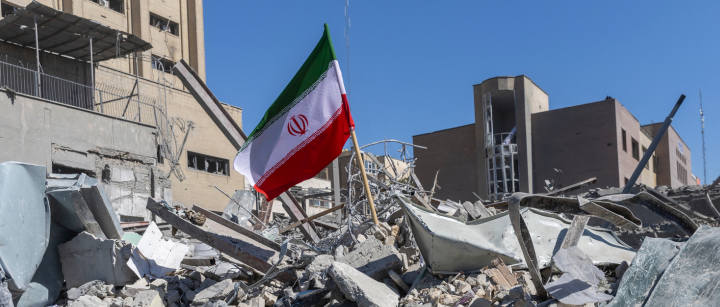
An Iranian flag is planted in the rubble of a police station, damaged in airstrikes on March 3 in Tehran. Photo by Majid Saeedi/Getty Images.
Hathaway said the only time that a president does not need advance congressional approval “is when the United States has been attacked and he must act quickly to protect the country.” She said the president is also “required to seek authorization from the United Nations Security Council,” since the U.S. long ago signed on to a U.N. Charter that prohibits unjustified uses of military force by one country against another.
But other legal experts have told us that the issue of legality isn’t so clear.
Peter Shane, a constitutional law scholar and adjunct professor at New York University School of Law, told us in June that it is “difficult to give a definitive